Flask – Cookies
A Request object contains a cookie’s attribute. It is a dictionary object of all the cookie variables and their corresponding values, a client has transmitted. In addition to it, a cookie also stores its expiry time, path and domain name of the site.
Reading back a cookie is easy. The get() method of request.cookies attribute is used to read a cookie.
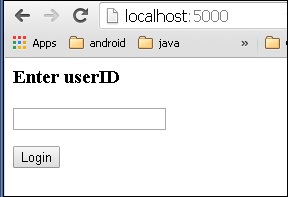
In the following Flask application, a simple form opens up as you visit ‘/’ URL.
@app.route('/')
def index():
   return render_template('index.html')
This HTML page contains one text input.
<html>
   <body>
      <form action = "/setcookie" method = "POST">
         <p><h3>Enter userID</h3></p>
         <p><input type = 'text' name = 'nm'/></p>
         <p><input type = 'submit' value = 'Login'/></p>
      </form>
   </body>
</html>
The Form is posted to ‘/setcookie’ URL. The associated view function sets a Cookie name userID and renders another page.
@app.route('/setcookie', methods = ['POST', 'GET'])
def setcookie():
   if request.method == 'POST':
   user = request.form['nm']

   resp = make_response(render_template('readcookie.html'))
   resp.set_cookie('userID', user)

   return resp
@app.route('/getcookie')
def getcookie():
   name = request.cookies.get('userID')
   return '<h1>welcome '+name+'</h1>'
Run the application and visit http://localhost:5000/
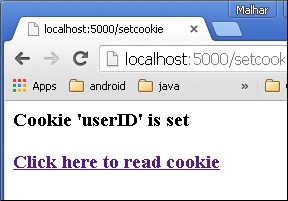
The result of setting a cookie is displayed like this −
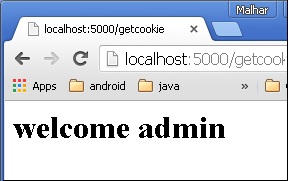
The output of read back cookie is shown below.